Air Compressor CFM Calculator — HP, PSI & Air Tool Demand
An air compressor CFM calculator that works both directions: size the machine from your tools’ duty-cycled demand at 90 PSI, or audit the machine you own with the tank-fill test — plus the absolute-pressure ratio that converts any rating from one PSI to another.
Compressor sizing dashboard
Step 1 — tick the tools on your line (CFM @ 90 PSI × duty cycle)
Demand build-up
Compressor class to buy
2 HP
≈ 7 CFM @ 90 PSI class · 5.0 CFM demand
Using 1 HP ≈ 3.5–4 delivered CFM @ 90 PSI (single-stage). Two-stage pumps deliver the same CFM from ~20% less HP — compare delivered CFM, never the horsepower sticker.
Checkpoint: demand numbers are planning-grade; the tank-fill test is the audit that keeps the purchase honest.
Six shop scenarios: what an undersized compressor really costs
Compressor sizing fails in a specific way: the tool datasheet sums look fine, the duty cycles are ignored, and the tank runs dry mid-task. Each card below pairs the common failure with the demand math that prevents it:
Finish nailer + brad gun workshop
Without the math
Single 2-gal pancake stalls on every trim job
With the math
Demand ≈ 1.1 CFM effective → 2 HP / 4–6 gal runs a full trim day
Impact wrench + die grinder garage bay
Without the math
Sticker CFM sums to 9 — but continuous grinding starves a 3-gal tank
With the math
Duty-cycled demand ≈ 3.8 CFM + 15% → 3 HP / 20–30 gal twin-stack holds 90 PSI
HVLP spray painting
Without the math
9 CFM continuous duty — the hardest single-tool load in the shop
With the math
Size 5 HP / 17+ CFM with a 60-gal reservoir; add an air dryer for water-free finish
Multi-station assembly line
Without the math
Datasheet sums lie: stations never cycle together, but leaks run 24/7
With the math
Duty-cycle the meter readings, ×0.6–0.8 simultaneity, +10–25% leaks → staged compressors
Pneumatic press / cylinder automation
Without the math
Cycle math from bore × stroke × pressure ratio, not tool charts
With the math
0.97 ft³ free air per 2 × 10 in. stroke @ 90 PSI × cycle rate = the real CFM
Shop upgrades over time
Without the math
Each new tool silently raises the duty-cycled floor
With the math
Re-run the demand tab quarterly; buy CFM headroom, not HP stickers
How to calculate the CFM of an air compressor you already own
Nameplate “CFM” numbers are optimistic by design — displacement at zero backpressure, or worse, a made-up “peak” figure. The tank-fill test measures what the pump actually delivers, and it needs nothing but a stopwatch:
CFM = (tank gallons × ΔP) ÷ (7.48 × 14.7 × fill minutes)
7.48 gal per ft³ · 14.7 PSI per atmosphere · the same formula the homepage formulas section keeps for quick checks
| 1. Drain the tank fully | start at 0 PSI | clean baseline |
| 2. Open every drain & let it run | standard test also tracks leaks | or isolate first |
| 3. Time the fill | 60 gal, 40 → 120 PSI, 5:00 min | ΔP = 80 PSI |
| 4. Apply the formula | (60 × 80) ÷ (7.48 × 14.7 × 5) | 8.7 CFM |
| 5. Compare to nameplate | within 5–10% = healthy | else: filter, belt, rings |
HP ↔ CFM at 90 PSI: the 7 CFM @ 80 PSI reality check
The most-searched number pair in compressors — “7 CFM at 80 PSI needs how many HP?” — resolves with one heuristic and one warning. The heuristic: single-stage shop pumps deliver 3.5–4 CFM per real HP at 90 PSI; two-stage industrial pumps reach 4–5. So 7 CFM @ 80 PSI ≈ 2–2.5 true HP. The warning: “peak HP” marketing multiplies real motor power by 1.5–2×, which is why a “5 HP” budget compressor often under-delivers a 2 HP spec.
| Real motor HP | Single-stage CFM @ 90 PSI | Two-stage CFM @ 175 PSI | Runs comfortably |
|---|---|---|---|
| 2 HP | 25.2 | — | One or two intermittent tools |
| 3 HP | 39.6 | — | One or two intermittent tools |
| 5 HP | 61.2 | 19.5 | A full garage bay or small body shop |
| 7.5 HP | 110.0 | 28.7 | A full garage bay or small body shop |
| 10 HP | 154.0 | 40.3 | A full garage bay or small body shop |
| 15 HP | 242.0 | 63.2 | Multi-station lines, plasma, sandblasting |
| 25 HP | 396.0 | 103.5 | Multi-station lines, plasma, sandblasting |
💡 Buy CFM, not horsepower
Two compressors with identical HP can differ 30% in delivered CFM depending on pump efficiency, RPM and staging. The spec that matters is delivered CFM at a stated PSI — ideally verified with the tank-fill test before the return window closes.
❌ Don’t: size from the tank
A bigger tank stores more air but makes none. A 60-gallon tank on an underpowered pump just takes longer to run dry — the duty cycle still loses. Tank size buys recovery time for high-flow bursts (impact wrenches, blow-off); pump CFM buys continuous work.
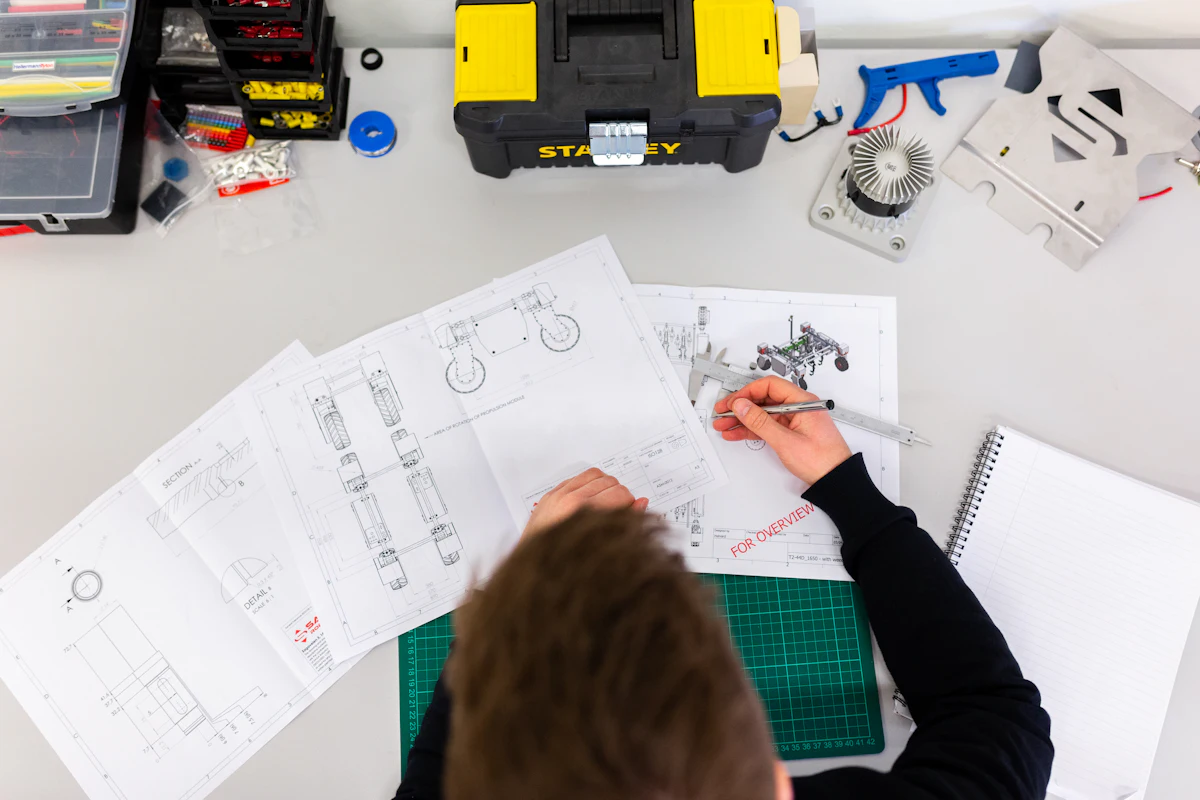 The tank stores; the pump delivers — size the pumpPhoto: Unsplash
CFM at 40 PSI, 20 PSI, or any other pressure: the absolute-ratio method
“How do you calculate CFM at 20 PSI?” and “calculate CFM at 40 PSI from 8.75 at 90 PSI” share one formula. Compression is proportional to absolute pressure, so a rating moves with the PSIA ratio — gauge PSI plus 14.7:
CFM₂ = CFM₁ × (PSI₁ + 14.7) ÷ (PSI₂ + 14.7)
Worked: 8.75 CFM @ 90 PSI → 8.75 × (104.7 ÷ 54.7) ≈ 16.7 CFM @ 40 PSI
| Rating | @ 20 PSI | @ 40 PSI | @ 90 PSI | @ 125 PSI |
|---|---|---|---|---|
| 4.00 CFM @ 90 PSI | 12.07 | 7.66 | 4.00 | 3.00 |
| 5.00 CFM @ 90 PSI | 15.09 | 9.57 | 5.00 | 3.75 |
| 8.75 CFM @ 90 PSI | 26.40 | 16.75 | 8.75 | 6.56 |
| 7.00 CFM @ 80 PSI | 19.10 | 12.12 | 6.33 | 4.75 |
| 12.00 CFM @ 90 PSI | 36.21 | 22.97 | 12.00 | 8.99 |
Air tool consumption at a glance (and how to stack them)
The demand tab uses duty cycles because air consumption calculation in CFM for real shops is never the datasheet sum. A sander drawing 11 CFM sounds impossible on a 3 HP compressor — until its 70% duty cycle meets the compressor’s own 100% rating honestly:
| Tool | CFM @ 90 PSI | Typical duty | Effective CFM |
|---|---|---|---|
| Brad nailer / finish nailer | 0.7 | 10% | 0.07 |
| Framing nailer | 2.4 | 20% | 0.48 |
| 1/2" impact wrench | 5.0 | 25% | 1.25 |
| Air ratchet | 4.0 | 20% | 0.80 |
| 4–5 in. angle grinder | 8.0 | 60% | 4.80 |
| Die grinder | 5.0 | 50% | 2.50 |
| Reversible air drill | 4.0 | 40% | 1.60 |
| Dual-action sander | 11.0 | 70% | 7.70 |
| HVLP spray gun | 9.0 | 50% | 4.50 |
| Blow gun (short bursts) | 4.0 | 15% | 0.60 |
| Air hammer / chisel | 4.5 | 30% | 1.35 |
| Cut-off tool | 6.0 | 50% | 3.00 |
Cylinders, dryers and vacuum pumps: the specialty math
Three calculations live at the edges of compressor sizing — automation, air treatment and vacuum work. Each has one formula and one trap:
Pneumatic cylinder air consumption
ft³ free air per stroke = (π × r² × stroke ÷ 1728) × (PSI + 14.7) ÷ 14.7
2-in. bore, 10-in. stroke @ 90 PSI: 0.136 ft³ × (104.7 ÷ 14.7) ≈ 0.97 ft³ per extension → × 30 cycles/min ≈ 29 CFM before the return stroke
Forgetting the rod-side volume on the return stroke — it re-enters air, not atmosphere, so double-acting cylinders cost more per full cycle than the extension math suggests.
Air dryer matching
Dryer rating ≥ compressor CFM × 1.2 (inlet is hot and saturated)
A 25 CFM compressor wants a 30 CFM refrigerated dryer; desiccant units additionally purge 10–15% of the dried air for regeneration
Sizing the dryer to the tool demand instead of the compressor output — the dryer sees everything the pump makes, not just what the tools use.
Vacuum pump CFM & pump-down time
t = (V ÷ S) × ln(P₀ ÷ P₁) — pressures absolute
6 ft³ vessel, 10 CFM pump, 14.7 → 3 PSIA: t = 0.6 × ln(4.9) ≈ 0.95 min; the last decade of vacuum takes as long as the first
Treating pump CFM as constant: displacement flow falls exponentially as the vessel empties, and 'air watts' rate suction work at the nozzle — not volume moved.
❌ The conversion that does not exist: CFM → bar / kPa / kg·cm²
CFM is flow; bar, kPa and kg/cm² are pressure. No conversion exists because the units describe different dimensions — the same way gallons-per-minute never equals tire pressure. The legitimate moves: convert CFM to other flow units with the CFM conversion calculator, or convert a rating between pressures with the ratio tab above. If a site offers “CFM to bar,” it is assuming a hidden condition — find the assumption before trusting the number.
Where this page stops — and which page takes over
This page sizes and measures compressors: demand stacking, the tank-fill audit, HP matching and pressure-ratio conversions. Two neighbors own the adjacent jobs: the SCFM to CFM calculator converts ratings between reference conditions (SCFM, ACFM, Nm³/h) with temperature and humidity corrections, and the CFM conversion calculator handles pure unit conversions (m³/h, L/s, CMH). When a datasheet says “12 SCFM” and your shop is at 5,000 feet, that is the SCFM page’s problem — this page cares only that the tools get their 90 PSI.
Air compressor CFM FAQ
TopHow do you calculate CFM for an air compressor?▼
Two directions. To size a compressor, add each tool's CFM at 90 PSI multiplied by its duty cycle (a die grinder is continuous work; a framing nailer fires seconds at a time), then apply a simultaneity factor if several people share the line. To measure a compressor you already own, use the tank-fill test: CFM = (tank gallons × ΔP) ÷ (7.48 × 14.7 × fill minutes). The calculator above runs both — the demand tab builds the shopping number, the test tab audits the machine in the garage.
How do you calculate CFM of an air compressor with the tank-fill method?▼
Drain the tank, run the compressor from cut-in to cut-out pressure, and time it. A 60-gallon tank filling from 40 to 120 PSI (ΔP = 80) in 5 minutes delivers (60 × 80) ÷ (7.48 × 14.7 × 5) ≈ 8.7 CFM at that mean pressure — roughly the pump's free-air rating with real-world losses included. Within 10% of the nameplate means healthy; substantially lower points to intake filter clogging, belt slip, or worn rings and valves.
How much horsepower for 7 CFM at 80 PSI?▼
The working heuristic is 1 HP ≈ 3.5–4 CFM delivered at 90 PSI for single-stage shop compressors, so 7 CFM at 80 PSI maps to roughly 2–2.5 HP — a common small-shop pancake or twin-stack rating. Two-stage industrial pumps do better (4–5 CFM per HP), and 'peak HP' marketing numbers do far worse; always compare delivered CFM at a stated PSI, never the horsepower sticker.
How do you calculate CFM at 40 PSI from a rating at 90 PSI?▼
Use absolute-pressure ratios: CFM₂ = CFM₁ × (P₁_abs ÷ P₂_abs) with P_abs = gauge PSI + 14.7. A tool that moves 8.75 CFM at 90 PSI (104.7 PSIA) moves 8.75 × (104.7 ÷ 54.7) ≈ 16.7 CFM at 40 PSI (54.7 PSIA) — because lower discharge pressure means less compression work per cubic foot. The same formula in reverse tells you what a 40 PSI spec is worth at 90.
How is air consumption calculated for a whole assembly line?▼
Multiply each tool's CFM at working pressure by its duty cycle measured on the floor (a stopwatch over ten minutes beats any datasheet), sum the results per zone, apply a simultaneity factor — typically 0.6–0.8 because not every station cycles at once — and add 10–25% for leaks. A healthy line leaks 10%; an ignored one loses 30% of compressor output through fittings and cracked hoses before a single tool fires.
How do you calculate air consumption of a pneumatic cylinder?▼
Cylinder volume = π × (bore/2)² × stroke, in cubic inches; air used per cycle = volume × (working PSIA ÷ 14.7) for both directions if the rod side is included. A 2-inch bore, 10-inch stroke cylinder at 90 PSI: π × 1² × 10 = 31.4 in³ = 0.136 ft³ per extension, ×(104.7 ÷ 14.7) ≈ 0.97 ft³ of free air per stroke. At 30 cycles per minute that is about 29 CFM — before the return stroke.
How do I size an air dryer to my compressor?▼
Dryers are rated in CFM at inlet conditions, and the inlet is hot and saturated — derate the compressor rating by about 20% when matching: a 25 CFM compressor wants a dryer rated 30+ CFM at its rated inlet temperature and pressure. Refrigerated dryers hit dewpoints of 35–40°F (fine for shop tools); desiccant dryers reach −40°F for painting and instrumentation, at the cost of 10–15% purge air drawn from your own supply.
How do you calculate vacuum pump CFM and pump-down time?▼
Vacuum pump CFM is displacement flow at the pump inlet, and it falls as the vessel evacuates because each stroke removes a fixed fraction of what remains: t = (V ÷ S) × ln(P₀ ÷ P₁), with V in ft³, S in ft³/min and pressures absolute. A 6 ft³ tank from atmospheric (14.7 PSIA) to 3 PSIA with a 10 CFM pump: t = 0.6 × ln(4.9) ≈ 0.95 min. Air watts — the suction-power metric on vacuum cleaners — divide inlet vacuum (inches of water) by airflow (CFM) with unit constants; they rate suction work, not volume moved.
Can you convert CFM to bar, kPa or kg/cm²?▼
No — and the reason is dimensional, not regulatory. CFM is a flow rate (volume per time); bar, kPa and kg/cm² are pressure units. Asking for a CFM-to-bar conversion is like asking how many gallons per minute a tire has: any 'converter' online is either converting between flow units (CFM↔m³/h↔L/min) or assumes a hidden pressure to do a specific task. What you can convert: a given compressor's CFM at one pressure to its CFM at another (the ratio method above) — pressure changes the flow, but never equals it.
How does this page relate to the SCFM converter and the homepage tank-fill formula?▼
The homepage keeps the bare tank-fill formula for quick health checks. This page builds the full demand picture: tool stacking with duty cycles, HP matching, pressure-ratio conversions, cylinder consumption, dryer and line sizing. For converting a rating between reference conditions — SCFM vs CFM vs Nm³/h — the SCFM to CFM calculator handles the temperature, pressure and baseline bookkeeping; this page stays on sizing and measuring.
Related Tools & Guides
CFM to FPM Calculator
Convert CFM to FPM and FPM to CFM for any round or rectangul...
CFM Conversion Calculator
Convert CFM to m³/h, CMH, CMM, L/s, LPM, m³/s and CFH instan...
CFM to BTU Calculator
Convert CFM to BTU and BTU to CFM with the 1.08 ΔT formula —...
Fan Performance Calculator
Calculate fan CFM from RPM with the affinity laws — static p...
Range Hood CFM Calculator
Free range hood CFM calculator: size kitchen hoods by cookto...
Attic Fan CFM Calculator
Attic fan CFM calculator: size attic exhaust at 0.7–1.0 CFM ...
SCFM to CFM Calculator
SCFM to CFM calculator with pressure and temperature correct...
Blower CFM Calculator
Blower CFM calculator: size any blower from wheel diameter, ...
Grow Tent CFM Calculator
Grow tent CFM calculator: size 2×2 to 4×8 tents by air chang...
CFM per Ton Calculator
CFM per ton calculator: convert tons to CFM at 350, 400 or 4...
Dust Collector CFM Calculator
Dust collector CFM calculator: match machine CFM demands, ke...
Paint Booth CFM Calculator
Paint booth CFM calculator: size cross-draft and downdraft s...
Air Purifier CFM Calculator
Air purifier CFM calculator: match CADR to room size with th...
Evaporative Cooler CFM Calculator
Evaporative cooler CFM calculator: size swamp coolers at 20–...
Air Handler CFM Calculator
Air handler CFM calculator: split supply vs return air, chec...
Engine CFM Calculator
Engine CFM calculator: size carburetors from CID and RPM wit...
Greenhouse CFM Calculator
Greenhouse CFM calculator: summer cooling at one exchange pe...
Bathroom Exhaust Fan CFM Calculator
Bathroom exhaust fan CFM calculator: size by room volume at ...
Air Changes per Hour Calculator
Convert air changes per hour to CFM and back with the ACH fo...
CFM to Square Feet Calculator
Turn CFM into square feet: coverage area from 700, 1500 or 3...
Whole House Fan CFM: Sizing Whole-House Fans, HRVs & ERVs
Size a whole-house fan at 2–3 CFM per sq ft or one air chang...
Size the pump, then audit it with a stopwatch
Duty-cycled tool demand in one tab, a tank-fill health check in another — the two numbers that keep the shop from going quiet mid-job.